Friday, April 3, 2009

Eine Kirche für Alles


A Church for All

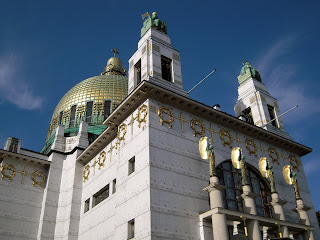
One of the many things for which we are grateful this year in Austria, is the opportunity to soak in the sights the “average tourist” might miss.  If you’re in a city for just a few days, time restrictions or locations well off the beaten path, might discourage a visit to an otherwise worthy destination.  Otto Wagner’s Kirche am Steinhof (also known as St. Leopold’s church) is one of those locations.  Only twice a week, on Saturday afternoons between 4 and 5, and during Sunday morning Mass, does one have the opportunity to marvel at this art nouveau gem.  In the reading we’ve done, authors agree, this church is one of the finest examples of art nouveau architecture in the world (see for instance, greatbuildings.com, timeout.com, findarticles.com/p/articles/mi_m0422/is_1_87/ai_n13592461/).
Kirche am Steinhof sits on the edge of the Vienna Woods, 1017 feet above sea level, so the gold dome atop the white marble edifice can be seen from all parts of the city.  (An extensive 2006 refurbishing included a total of nearly five pounds of gleaming gold gilding for the 105-foot cupola.)  This church’s placement is unusual, not because of the height, and not because of the close proximity to the woods, but because it is the focal point of Vienna’s largest public psychiatric hospital. At the turn of the century, Viennese psychiatric theory and practice recommended natural healing environments for patients.  This inspired the creation of a 274-acre mental health facility, surrounded on three sides by the lovely Wienerwald.  In 1902 Otto Wagner himself designed the ground’s layout and many of its 60 buildings including a theatre where performances are still given.
Our favorite tourbook, Time Out Vienna, stated Wagner’s hope that his church would be a shrine for all religions.  Wagner felt that all patients, regardless of religious affiliation, deserved to have a beautiful place of worship where they would feel comfortable.  To that end, he took great care in the design of even the smallest details.  While in the planning stage, Wagner consulted with psychiatrists to be certain his church would be comfortable for all worshipers, particularly those with mental and neurological health challenges.  The church was built between 1904 and 1907, with very practical features such as numerous and easily accessible bathrooms, special emergency exits, a room for a doctor and emergency staff, pews of different widths with no sharp edges (for comfort and safety), continuously flowing holy water instead of a basin (more sanitary), a slightly raked theatre-type floor for easy viewing of the altar even from the back pews, and tile covering most surfaces (clean-up is a breeze!). 
Although practical, the church is also visually stunning and filled with thoughtful symbolism.  For instance, the elaborate and colorful mosaic behind the ornate altar represents the reception of the departed soul into heaven. Those saints attending the celebration include Saint Dymphan the patron saint of those afflicted by epilepsy or mental illness and Saint Clement Hofbauer, the patron saint of Vienna.


In another stroke of genius, the church sits on a north-south axis, so light pours in the magnificent windows created by Koloman Moser, friend of Wagner and an art nouveau master.  Each of the seven window panels portrays a saint, each fulfilling Christ's physical and spiritual commands (feed the hungry, visit the sick, etc.); above the saints fly a pair of angels (with awesome wings) who are holding a quotation from the Gospel of Matthew “whatever you did for one of the least of these brothers or sisters, you did for me.”
(We particularly like this photo because you can also see the one of the chandeliers.)

Speaking of angels, four beauties stand as the greeting committee above the front entrance of the church.  Then, when you exit and look back to again take it all in one more time, it also seems the angels are inviting you to return!

Peace!

Wednesday, March 25, 2009

Verloren und Gefunden


Lost and Found
Leoben, Austria is nestled in a rich river valley, surrounded by gently rolling hills. Rather than an uninterrupted block of habitation, Leoben’s neighborhoods  lie in the many pockets of land that are interspersed by the bends of the Mur River, which flows back and forth, back and forth, in a serpentine pattern.  The three main sections of town are connected by bridges for pedestrians – and if you really must drive an automobile, a ribbon of highway skirts the south and east edges of Leoben. 
We love to "wander," the inviting Austrian method of of hiking, walking in the woods, with a rest or a snack or two along the way.
Guten Morgen Spring Chickens!
Doesn't this look like a tempting stop for refreshments?

During the first weekend of March, Spring was doing its darnedest to make an entrance in der Steiermark.  We also made an entrance to our second Austrian home with our hiking shoes, eager to take advantage of a gorgeous day.  Our trek led us through happy farms, and greening meadows.  Then as we climbed higher, we were met by melting ice and snow, which sometimes turned our hiking into skating.  After a few morning “wanderen” hours, we made our way through the woods and came upon an adorable farm and gasthaus.  We enjoyed a delicious lunch and the jovial company of the proprietors and the many locals soaking in the Sunday sun.

It looks like the middle of a farmer's barnyard - and it is - but when you walk down this path you enter a magical land of eats and drinks!

Sated, amused, and feeling adventurous, we ascended the hill in another direction, and then descended on another side.  Then we went up a neighboring hill and down yet a different direction. Imagine our surprise a couple of hours later when we reached a clearing to realize we had hiked to the faaaaaaaaaar edge of town – we had actually reached the next village. It was about 4:30, starting to get dark, and the hill we were on was surrounded either by a highway and/or the river. From our bird’s eye view we saw exactly where we needed to go, and it appeared we might be able to successfully scamper down, but once down, how in the world would we get across the highway? 

You know what happened to Hanzl and Gretel when they got lost in the woods?!  We were determined this fate would NOT befall us.  So, with the sun sinking, we did what any good Austrian would never do – we climbed over and under fences on to private property. (Well, an Austrian probably wouldn’t get lost in the first place.)  Our thinking:  where there is pasture, there must be a farmer. Sure enough - we unintentionally frightened the diligently working Austrian farmer when we simultaneously apologized for trespassing and asked for directions.  Though we were still some distance from our goal (Mutti Theisl and her waiting kuchen), the kindly farmer assured us we’d make it UNDER the highway (those clever Austrians), into town, and to Mutti’s doorstep before sunset.  Thanks to his precise directions, the nice farmer was right.  After Mutti spoiled us, she sent us back to our most excellent Leoben lodgings where we slept like Austrian rocks. 
Travis receives Divine Guidance on reaching the Mutti Theisl's before the sun goes down.

The next day we gave a presentation at the monthly meeting of the upper Steiermark English Circle, chaired by our dear friend, Professor Frau Doktor Augustin.  The greatest adventure in the two+ hours we spent with this pleasant group of community and university leaders was navigating the lively and extensive question and answer period – Gott Sei Dank because we were exhausted from the previous day’s quest.  The hills and the English Circle have been calling, so we’ll make another visit later this Spring.
Who is the dog and who is the pony in this show? We'll let you decide.  
Mutti Theisl (in the purple), and her friends Krista (in the grey) and Tony (our photographer), attended our presentation.  Please keep in mind, Mutti doesn't speak any English.
Appreciation given in the form of Austrian chocolate - always a winner.
Mutti sees us off at the Bahnhof.  Each time we depart Leoben she hands us a real Austrian Jause (think hearty sack lunch) for our 2-hour trip home to Vienna.  She'll add "well, you just don't know when a beer or a salami sandwich may come in handy."  

Friday, March 20, 2009

Das Leopoldstadts Leben

Life in Leopoldstadt
Whilst residing in Leopoldstadt last month, we enjoyed Viennese life in another part of the city, the 2nd district. We know from our history and tour books, and from our December tour with Professor Klaus from the Uni Graz, this district, just beyond the city’s “inner ring,” was originally a Jewish neighborhood. Then in 1669, Leopold I, was badgered by many (including his wife) to expel the Jews and give the whole neighborhood (shops, cafes, apartments, everything) to Christians. Thus, the district was named Leopoldstadt. Ironically, in the 19th and early 20th centuries, Leopoldstadt was the primary neighborhood for Jewish refugees fleeing Eastern Europe. Memory stones and plaques memorialize the fate that befell many of those same refugees in the 1930s and ‘40s. Today, the 2nd district continues to be a center of the Jewish community, as well as home for new immigrants and refugees from Eastern Europe, the Middle East, Africa, and Asia. This makes for interesting touring with your eyes, ears, and taste buds. (Let us know if you are ever craving authentic Korean cuisine when you are in Vienna – we can tell you where you need to go.)
One of the hundreds of Memory Path plaques ("Weg der Erinnerung") on the sidewalks all around the 2nd district. We saw this plaque every day because it is right in front of our favorite grocery store, just around the corner from our appartment.

This section of Wien sustained considerable damage during WWII, so much of the original architecture is sadly gone. Still, a few real 2nd district gems remain, namely the Augarten park, Prater, and the once-grand Prater Strasse, the long-time home of Johann Strauss. (In our November Flakturm blog, we wrote about the impressive Augarten park -- the oldest Baroque garden in Vienna. A quick review: the park expands 2 square miles of meticulously manicured walking paths, green space, gardens, trees, and the famous/infamous massive flak towers.)
An Augarten yoga practice in the fall. Vrksasana (tree pose) is particularly inspired in such an environment.

Prater is only a five-minute walk from our flat, so Prater, not Augarten, was our park of choice while living in the 2nd district. Semantically, Prater is less of a “park” and more of a “forest” since it covers 23 square miles. The area was originally a royal hunting ground (as was Augarten), but was opened to the public in 1766 (Augarten was opened in 1775). We’ve enjoyed Prater’s stately boulevard and the surrounding oak and chestnut woodlands in late summer, fall, and now winter. By now we shouldn’t be surprised that droves of Viennese of all ages and physical abilities, would be walking and biking, even in very chilly months. Our favorite tour book, Time Out Vienna, states the tree-lined main boulevard, the 2-miile long Hauptalle, “…has been synonymous with a Viennese Sunday stroll since it was opened …” We’ve been part of that tradition through what some call Wien’s “green lung”.
Trav stands outside the Prater History Museum which houses all sorts of fantastic Prater artifacts, maps, photos, etc. Inside, we were especially impressed with documentation of yearly park transformations in the early 1900s. For instance, one year the park was remodeled to look like Venice. The next year, "a journey to Africa" or "the Far East" could be the theme. We were also a little creeped-out by the unfortunate display of "freaks" (bearded lady, lion man, fattest baby, tallest man, pin heads, etc). Oh dear.

This Riesenrad photo was taken after a late-afternoon stroll through the woods last fall.

Although our favorite area of Prater’s 23 square miles is the woodlands, the most famous corner is probably the amusement park (carousels, bumper cars and roller coasters) and of course, the Riesenrad, the giant wheel. The Riesenrad, made famous in the Orson Welles film The Third Man, was completed in 1897 to celebrate Franz Josef’s Golden Jubilee. The 15 wooden gondolas (originally there were 30) are in motion year round. Each gondola can accommodate 20 people, and you can even rent a gondola for a wedding or other special event, or the Prater even caters meals in the cars – remember, regardless of where you are in Wien, food cannot be far away. During a slow and exciting 20 minutes, the giant wheel takes you up 213 feet to take in the city’s view. In 2002 we rode the Riesenrad about one hour after our arrival to town; this year we’ve enjoyed reading about its history in the Prater museum and seeing the giant wheel from the terra firma, but we’ve yet to be carried by the giant!
Relishing a Christmas Eve Prater stroll with true Viennese - our beloved Kupkas, who are Hauptalle regulars. Note Frau Kupka's walking sticks. Such sticks are all the rage in all seasons.


Johann Strauss (the younger) lived just down the street on Prater Strasse, a five-minute walk to both the Prater Hauptalle, and our flat. In Strauss’s spacious 2nd-floor apartment, we marveled at the beautiful grand piano, organ, violin, and stand-up composing desk, all used by Wien’s beloved waltz king. The original manuscript for the Blue Danube Waltz, composed in this house, is also on display! After paying homage to one of Vienna’s favorite sons, we danced downstairs to the ¾ time Café (clever name, eh?) for a scrumptious lunch with musical accompaniment. The unexpected note was the ¾ time Café was not playing Strauss, nor any other Wiener waltz; instead, they were playing ABBA from a boom box.
1-2-3, 1-2-3, 1-2-3 . . .

Karla really wanted to put on the dress but the docent discouraged such behavior.
Yes, this is it! The original Blue Danube score! Everyone hum along now.
They are all here, meine Damen und Herren, waltzes, marches, polkas - even quadrilles!

Wednesday, March 11, 2009

Friday, March 6, 2009

Saturday, February 21, 2009

Reisen mit Travis

Travels with Travis

“Travel only with thy equals or thy betters; if there are none, travel alone.”  

(Quotation from the Dhammapada, traditionally ascribed to Buddha)


 Buddha would have loved my travel partner, my better. 

He is always on the look out for danger.  Perhaps that is why we never encountered any during our six-week journey.

He is prepared for every circumstance.  Here we see the “from closed-in-the-bag to in-the-open-position” umbrella time trials.  On occasion, he even practiced with his eyes closed.  (If you are interested, I'd be pleased to send you the entire eight-photo series.) 

He is persistent.  Ne’er would Travis rest until he found an Internet connection - and if not in our accommodations (access was sketchy), he scoured the town in search of a way to be in contact with his NWU colleagues. Shown here in our superb Salzburg lodgings, Travis is pleased with his connection success (leave it to a dorm to provide one of the only places with reliable Internet access). 

He is not afraid to show his true of feelings.  Here we see the realization the Stiegl brewery was closed for the day. Poor Trav.

He is an enthusiastic learner.  In every city Travis was keen to discover all he could about the history, the people, the culture.  Inspired by the statues, which at one time embellished the massive Porta Nigra in Trier, Travis embraces active learning in Porta Nigra's adjoining museum. 

He is open-minded.  During our stay in Marburg, Travis grew to like these creepy monkey creatures which appeared here and there around the town.

He is adventurous.  Travis is undaunted by the warning that, behind the red velvet curtain, this portion of the Grimm’s Fairy Tale exhibit shows pornographic images. 

He is versatile.  He confidently makes polished presentations to faculty, staff, and students; he’ll joyfully take them one-on-one or in groups as large as 200.  He is techno-guy, literature-guy, backgammon-playing-guy. He gladly dines in student cafeterias or four-star restaurants.  He skillfully irons his shirt to within an inch of its life, puts it on, and then goes to the ball where he keeps up with Austrian dancers until 2 a.m.  The next day he will pre-treat and wash his shirt in preparation for the next big event. 
He is tidy.  Not only is he an expert sink-washer, he is also creative with solutions for faster drying, as well as solutions for efficient packing. 

He is a master at carrying luggage up stairs, over cobblestone, through narrow hallways, in snow, sleet, and rain.  As seen in this photo we have rain on a travel day – AGAIN.   Travis, my favorite travel partner and my better, is also a master at carrying a conversation with finesse.

Sunday, February 15, 2009

Verreisen mit einer Aussicht

Traveling with a View
Train travel is a peaceful, relaxing method of transportation. Austrian and German trains are timely, efficient, comfortable, quiet, clean.  We thoroughly enjoyed the past weeks’ excursions via the rail.  We had the erroneous idea we would get a lot of reading done on the train, but when it was daylight, instead of having our noses in books, they were pressed against the windows. 
Looking down the tracks from the last car (which sometimes is the first car).  A cool view.
Breathtaking mountains between Leoben and Salzburg
A winter wonderland between Salzburg and Linz
Along the Danube outside of Linz
Sunset between Linz and Frankfurt
Surprisingly green fields in the Moselle river valley
Beautiful river villages along the Rhine on the way to Trier
Farmland just outside of Munich - doesn't it look a bit like Nebraska?
This incongruous juxtaposition struck us as tragically surreal.
Almost home - about 45 minutes outside of Wien - the lovely Falkenstein.  The plethora of deer and peasant in this area should also be noted - it was hard to keep Travis on the train.